How to Comment Like a Boss on LinkedIn in 2026

Updated: Jan 19

What's in this Post
LinkedIn isn’t just a place to share career updates; it’s a powerful stage for founders to build authority, attract customers, and grow a genuine community.

And here’s what actually sparked this post: inside the Superpath community on Slack, someone raised a really interesting question.
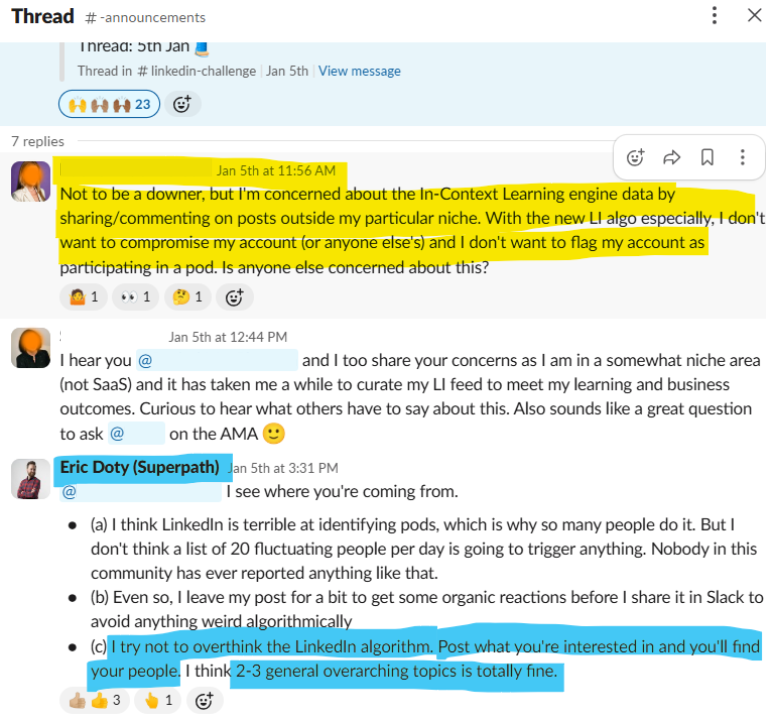
They wondered if commenting on LinkedIn posts outside their niche was a good idea or if it flag her account as participating in a pod. It turned into a thoughtful discussion among other content marketing leaders and founders.

And here’s another angle that got everyone talking: LinkedIn comments can now appear in Google search results, which means your insights could help new people discover you right from a search page.

Here’s the thread that sparked this post: LinkedIn comments showing up on Google = a new opportunity for discovery.

It’s like LinkedIn is giving you a whole new visibility play and a chance to be found in unexpected ways like Google.
So, if you’re a founder, solopreneur, or consultant wondering why stepping outside your usual lane to comment on LinkedIn can be such a smart move, this is for you.
This guide breaks down how it all works, why it’s a game-changer, and a simple framework (including a 7-Day Comment Plan) to get started.
Let’s dive in!
Why you should thoughtfully comment on LinkedIn
If you’ve got a high-value service or product, LinkedIn can help you zero in on the right contacts—no need to flood strangers with cold DMs.
Instead, think of it this way: start by strategically joining conversations in the comments section. You already know the value of being a thought leader, but figuring out where to engage can feel a bit overwhelming. Here’s the good news: building your executive brand isn’t just about staying in your lane.
One of the most impactful ways to stand out is by commenting and sharing insights outside your immediate niche. This is where In-Context Learning (ICL) algorithms come into play. On LinkedIn, this approach helps people recognize you not just for what you do, but for how you think.
In 2026, jumping into conversations outside your usual territory is a huge plus. It gets you noticed by new pockets of people—these “interest clusters” that LinkedIn’s algorithm loves to highlight. In other words, it’s a fantastic way to expand your reach and give your profile a nice signal boost.
How commenting outside your niche helps the algorithm
Modern social media platforms build a dynamic interest graph about you. When you engage outside your niche, the algorithm sees you as someone whose insights are versatile and valuable in multiple contexts. This doesn’t dilute your authority; it actually amplifies it. People see you as a thought leader who can connect the dots across different areas.
Instead of:
“Tech Founder”
You become:
“Tech Founder + Leadership + Speaker + Angel Investor + AI + Wellness”
This widens where your LinkedIn content can be tested.

Strategic Benefits of Diversified Commenting
Wider Visibility: Commenting on posts outside your niche allows you to bypass the traditional first-degree network limit. Your profile becomes visible to the original poster's unique network and everyone else in that thread, often generating 30–75x more views than a simple "like".
Algorithm "Activity" Signals: The 2026 algorithm heavily rewards active users who engage across the platform. Diverse engagement helps the algorithm categorize your profile more broadly, which can indirectly boost the distribution of your own niche-specific posts.
Networking with Decision-Makers: Engaging thoughtfully on high-visibility or trending posts can place you directly in front of decision-makers and customers who might not otherwise encounter your niche-focused content.
Testing Your "Voice": Commenting on broad topics like entreprenuership or general industry news serves as a low-risk way to test different tones and perspectives before committing to original long-form content.
How It Benefits You:
Richer Interest Graph: You’re no longer just tagged as a “CEO” or “founder.” Instead, the algorithm recognizes you as someone who engages thoughtfully in leadership, AI adoption, startup building, and more. This expands where and how your content gets tested in feeds.
Cross-Pollination: By commenting on posts from founders, other industry leaders, or even topics adjacent to your field, you attract new micro-audiences who might later engage with your core content.
Contextual Recall (ICL behavior): Platforms remember how you show up in different contexts.
Later, when someone in your niche:
scrolls
searches
follows a similar creator
The system recalls:
“You show up well in conversations like this.”
Your post gets surfaced faster.
Authority Transfer: High-quality comments outside your niche help you:
Borrow credibility from the original post’s audience
Signal pattern recognition (a high-value trait)
Position you as a thinker, not a topic silo
This is especially powerful for:
founders
consultants
marketing leaders
community builders
Framework for Commenting Outside Your Niche
To make this actionable, here’s a simple framework you can use whenever you’re commenting on posts outside your immediate domain:
Mirror: Acknowledge the core insight of the post. Show you understand the context.
Reframe: Add a strategic lens or a pattern you’ve noticed. This is where you bring in your expertise.
Apply: Ground it with a real-world application or a quick example.
Extend: Invite a further thought or leave the door open for continued conversation.
Here's a few example using the the first three frameworks for a founder and operator leadership niche:
What the algorithm reads:
Decision-maker proximity + strategic fluency
Comment Formula
This resonates because [mirror].
What I see most founders underestimate is [reframe].
The teams that scale tend to [apply].
Example
This resonates because clarity compounds faster than hustle. What I see founders underestimate is how much ambiguity taxes a team’s execution. The teams that scale usually invest early in narrative alignment, not just metrics.
This ensures your comments are always seen as high-signal contributions rather than just social reactions.
2026 Best Practices for Commenting on LinkedIn Posts
Avoid "Generic" Comments: Low-effort replies like "Great post!" or "Agree!" have negligible impact. In 2026, comments must be useful—offering a quick insight, a personal example, or a thoughtful question.
Target the "Golden Window": The most effective comments are made within the first 10–15 minutes of a post's publication. These comments stay at the top of the thread and benefit most from the post's initial growth phase.
Connect Back to Your Brand: When commenting outside your niche, subtly relate the topic back to your expertise. For example, if commenting on a post about psychology, link it to your niche (e.g., "This psychological principle also applies to how we build high-performing teams").
Avoid Rage Bait: Engaging in controversial or negative threads outside your niche can tarnish your credibility.
These dilute signal relative to your goals:
🚫 Creator economy drama
🚫 Generic productivity hacks
🚫 Trend-chasing memes
🚫 Politics (unless directly tied to work)
Focus on posts that align with your values or personal brand.
LinkedIn Commenting Don'ts
🚫 Low-effort reactions everywhere
🚫 Random engagement with no POV
🚫 Commenting just to “be seen”
ICL systems weight semantic depth, not volume.
Before commenting on a Linked post, ask yourself:
“Does this show how I think, not just what I know?”
If yes → comment.
If no → scroll.
Now let's try a comment plan to get you started!
7-Day Comment Plan (Example Prompts)
How to use this
Each day:
Comment on 2 posts
Use one primary prompt + one lighter prompt
Keep each comment 2–4 sentences
Text first. GIF optional only on the lighter one.
📅 Day 1 — Founder Clarity + AI Strategy
Goal: Authority + relevance
Comment #1 (Founder / Operator)
This resonates because clarity scales faster than hustle. What I see teams underestimate is how much ambiguity slows execution. The strongest orgs invest early in narrative alignment, not just metrics.
Comment #2 (AI Adoption)
The insight here isn’t the tool, it’s how teams adapt around it. Adoption breaks when AI is layered on without change management. The wins I’ve seen come from redesigning workflows first.
📅 Day 2 — Community-Led Growth + Career
Goal: Differentiation + trust
Comment #1 (Community)
This works because people feel seen, not managed. Community breaks when it’s treated as a channel instead of a relationship. Sustainable growth comes from participation loops, not constant programming.
Comment #2 (Career Transitions)
This hits because career shifts are rarely linear. The part people don’t say out loud is how much identity changes lag behind role changes. Giving yourself permission to be “in between” matters.
📅 Day 3 — Women in Leadership + Founder POV
Goal: Values + systems thinking
Comment #1 (Equity & Leadership)
Appreciate this framing because it focuses on outcomes, not optics. Equity becomes real when access and sponsorship are operationalized. Systems matter more than statements.
Comment #2 (Founder POV)
This is such a real tension. What often gets missed is how much context leaders hold versus what teams receive. Closing that gap usually unlocks speed and trust at the same time.
📅 Day 4 — AI + Modern Work
Goal: Strategic depth
Comment #1 (AI Strategy)
What stands out here is the emphasis on judgment, not automation. Teams struggle when AI replaces thinking instead of augmenting it. The best use cases elevate human decision-making.
Comment #2 (Modern Work)
This resonates because flexibility without clarity creates its own friction. The teams that thrive tend to pair autonomy with strong expectations and feedback loops.
📅 Day 5 — Community + Wellness (Professional Lens)
Goal: Humanity without oversharing
Comment #1 (Community Building)
This is a great reminder that trust compounds quietly. Community doesn’t scale through volume; it scales through consistency and care. Retention is the real signal.
Comment #2 (Burnout / Wellness)
This resonates because burnout is often framed as a personal issue. What’s missed is how work design drives energy depletion. Sustainable teams plan capacity, not just output.
📅 Day 6 — Industry Knowledge + Founder Insight
Goal: Credibility + translation skill
Comment #1 (Knowledge / Messaging)
This matters because expertise alone doesn’t guarantee impact. The opportunity is translating knowledge into accessible narratives. Brands that do this well meet audiences where they already are.
Comment #2 (Founder Insight)
This is a good example of where content isn’t about volume, it’s about coherence. When messaging aligns with lived experience, trust follows naturally.
📅 Day 7 — Reflection + Light Relationship Builder
Goal: Recall + warmth
Comment #1 (Reflective Leadership Post)
This feels true because growth often looks quieter from the inside. Progress shows up less as momentum and more as better decision-making over time.
Comment #2 (Relationship / Celebration)
Love seeing this milestone. It’s clear how much intention went into the process, not just the outcome. 👏(Optional subtle GIF here)
Now it's your turn! Get to commenting.
You don’t need to post every day to build authority on LinkedIn.
You need a point of view — and a simple system to show up consistently.
Now you have one. 🎉
If you’re a founder with a brain full of ideas but no clear strategy to turn that into content, then I can help you shape your genius into a LinkedIn presence that builds trust (and attracts the right people).


